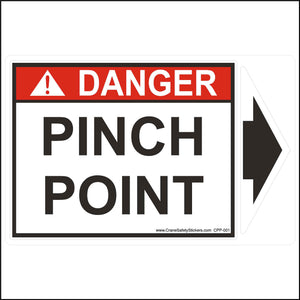
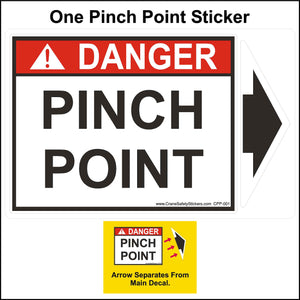
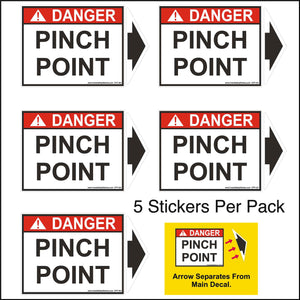
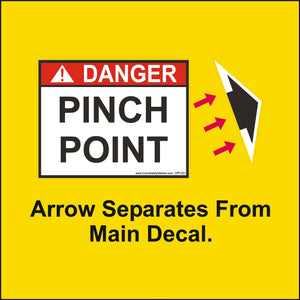
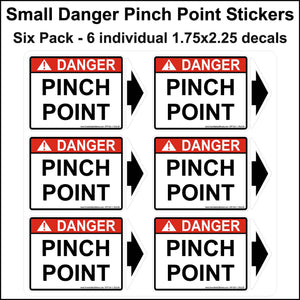
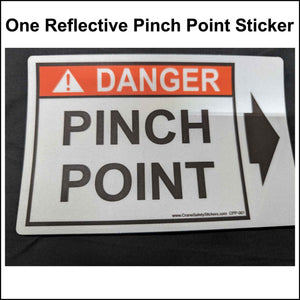
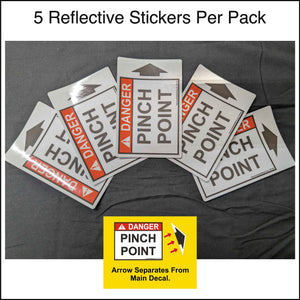
Need to meet OSHA 1910.145 and ASME B30 compliance for crush hazards? These industrial-grade pinch point hazard labels provide high-visibility warnings where safeguarding cannot fully eliminate mechanical pinch, shear, or crush hazards on heavy machinery.
Pinch Point Hazard Labels and Decals
Pinch point labels serve as secondary hazard warning systems to communicate residual risks where physical guarding cannot fully eliminate mechanical crush hazards, in accordance with
OSHA 29 CFR 1910.145,
OSHA 29 CFR 1910.212, and
ASME B30 standards. These labels provide standardized hazard communication to meet regulatory compliance requirements for industrial machinery, manufacturing equipment, and crane operations.
Under
OSHA 29 CFR 1910.145 and
ASME B30 safety codes, mechanical crane and heavy machinery components presenting crush or shear hazards must be marked with legible hazard identification signs. Non-compliant, missing, or degraded labels constitute a violation of safety standards. Standardizing fleet markings with specification-grade labels ensures continuous compliance with regulatory oversight and maintains safety documentation requirements during scheduled equipment inspections.
Regulatory Specifications for Compliant Pinch Point Labeling
-
OSHA 29 CFR 1910.145 Compliance: Standardized hazard communication is governed by OSHA 29 CFR 1910.145 (Specifications for accident prevention signs and tags). Safety labels must adhere to
ANSI Z535.4 (Product Safety Sign and Label System), requiring a standardized "DANGER" (red) or "WARNING" (orange) header, a graphical hazard symbol, and a specific hazard statement detailing the risk and avoidance action.
-
Legibility and Maintenance:
OSHA 29 CFR 1910.145(f)(3) and
ASME B30.5-2.3.1 mandate that safety labels be maintained in a clean and legible condition. Labels must withstand environmental exposure, including UV radiation, grease, hydraulic fluid, and mechanical abrasion, to prevent degradation and loss of legibility.
-
Placement and Material Requirements: Labels must be positioned adjacent to the specific hazard zone and visible to personnel prior to exposure. Materials must utilize high-tack, permanent acrylic adhesives and UV-stabilized face stocks to ensure permanent bonding to raw, painted, or powder-coated metal substrates.
Operational Standardization and Environmental Durability
Implementing standardized, high-durability hazard labels across all equipment classes minimizes maintenance cycles and reduces the risk of non-compliance due to environmental weathering. Using engineering-grade materials, such as cast vinyl or sub-surface printed polycarbonate, ensures the labels withstand continuous operational cycles in extreme marine, industrial, or construction environments. Uniform labeling practices across equipment fleets facilitate safety audits and support standard operating procedures (SOPs) for equipment inspection.
Required Label Placement Under OSHA and ASME Standards
Under
ASME B30.2 (Overhead and Gantry Cranes) and
ASME B30.5 (Mobile and Locomotive Cranes), hazard warnings must be affixed directly at or adjacent to identified hazard interfaces. Mandatory placement locations include:
- Outrigger stabilizing beam housings and hydraulic cylinder shear points.
- Superstructure counterweight swing clearance boundaries (in compliance with
OSHA 1926.1424).
- Sheaves, hook blocks, rope drum assemblies, and winch interfaces.
- Engine hoods, hydraulic access compartments, and mechanical linkage interfaces.
| Crane Sub-System |
Recommended Label Location |
Reference Standard |
Signal Word Severity |
| Outriggers |
Outer surface of telescoping outrigger beams and jack housings |
ASME B30.5 /
OSHA 1910.180
|
WARNING (Orange) |
| Superstructure |
Rear swing radius hazard areas and rotating frames |
OSHA 1926.1424 /
ASME B30.5
|
DANGER (Red) |
| Sheaves/Blocks |
Both sides of lower hook block side plates and sheave guards |
ASME B30.5 /
ASME B30.2
|
WARNING (Orange) |
| Trolley Drives |
Drive gear mesh points and end truck housing covers |
ASME B30.2 /
OSHA 1910.179
|
WARNING (Orange) |
Technical and Material Specifications
-
Base Material: 4-mil high-gloss cast vinyl or 5-mil subsurface-printed polycarbonate (resistant to tensile tearing, shrinkage, and dimensional distortion).
-
Overlaminate: 2-mil clear, UV-stabilized polyester film for protection against solar degradation and weathering.
-
Adhesive: High-tack, solvent-based permanent acrylic adhesive engineered for low- and high-surface energy substrates (metal, powder coatings, and textured surfaces).
-
Temperature Limits: Operational performance range from -40°F to 250°F (-40°C to 121°C).
-
Chemical Resistance: Certified resistance to diesel fuel, hydraulic oil, lubricating grease, engine coolant, aliphatic solvents, and salt spray exposure.
-
Regulatory Alignment: Fully compliant with
ANSI Z535.4 and
OSHA 1910.145 design, color, and layout protocols.
Frequently Asked Questions (Technical & Regulatory)
What is the mechanical definition of a pinch point on industrial equipment?
Under OSHA and ASME standards, a pinch point is defined as any point or location where it is possible for a part of the human body to become caught, pinched, or crushed between the moving parts of a machine, or between moving and stationary parts (e.g., rotating crane superstructures, outrigger beams, or cable drum sheaves).
How do you choose between a WARNING and DANGER signal word for pinch point labels?
Under
ANSI Z535.4 guidelines, the signal word is determined by the severity of the potential injury. A "DANGER" label (white text on a red background) is reserved for the most extreme hazards where severe injury or death
will occur if the hazard is not avoided. A "WARNING" label (black text on an orange background) is utilized where the hazard
could result in death or serious injury. Most external crane crushing hazards utilize the "WARNING" signal word.
How must the application surface be prepared to prevent decal peeling?
Substrate surface preparation is critical to ensure permanent bonding. The metal or powder-coated surface must be completely degreased using an isopropyl alcohol (IPA) or high-strength solvent wipe. All rust, scale, and peeling paint must be wire-brushed or sanded down. The substrate must be completely dry and at a temperature above 50°F (10°C) during application to facilitate chemical cross-linking of the acrylic adhesive.