Why This ASME B30.5 Mobile Crane Hand Signal Chart is Critical for Your Fleet Operations
As an owner of a crane company, your operational priorities are straightforward: safeguard your crew, mitigate corporate liability, and maintain the continuous profitability of your fleet. Miscommunication is one of the leading causes of fatal rigging and lifting accidents. When an inspector audits your site, any ambiguity in communication protocols is an immediate, citeable offense. Relying on deteriorating, non-standardized stickers exposes your operation to unnecessary risk and operational downtime.
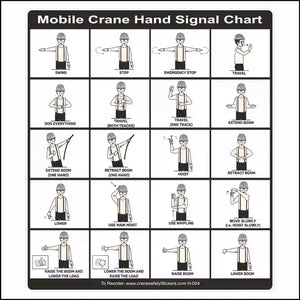
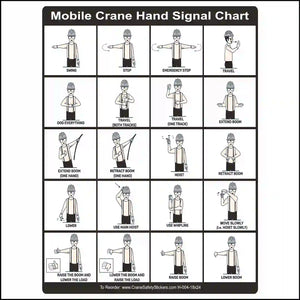
The solution is permanent, standardized compliance. This OSHA-compliant crane signal sticker serves as a mandatory reference tool for crane operators and a Qualified Signal Person. Standardization OSHA 1926.1419 requires that hand signals be uniform across a job site. By integrating this standard mobile crane hand signal chart, you ensure everyone is speaking the same visual language, preventing miscommunication during complex maneuvers such as "Raise the Boom and Lower the Load" or "Move Slowly."
OSHA mandates that a signal chart be posted on the equipment or conspicuously in the vicinity of the hoisting operation. Placing this durable 7" x 8" decal directly on the crane cab or operator station ensures constant visibility for both the operator and the crew. Furthermore, this chart applies to *any* mobile crane requiring standard hand signals, not just a Galion Crane 150F. Whether you operate Terex, Grove, Liebherr, or other equipment, this decal ensures your fleet passes inspection and your crews execute lifts with uncompromising precision.
Fleet-Grade Reliability and Cost-Savings
-
Regulatory Exactitude: Features the mandatory Standard Method hand signals required by OSHA 1910.179, OSHA 1926.1422, and ASME B30 standards. Mobile cranes fall under ASME B30.5, while overhead/gantry cranes are ASME B30.2; this chart strictly aligns with ASME B30.5 to prevent compliance citations.
-
High-Visibility Verification: Printed with high-visibility, UV-resistant inks that meet ANSI Z535 standards for safety colors. Will not fade in the sun, ensuring your crane operator can clearly read the chart in all conditions.
-
Long-Term Procurement Savings: Eradicates the hidden costs of recurring maintenance. By utilizing industrial-grade materials, this Standard crane hand signals poster for the cab eliminates the need to replace stickers every month, preserving your maintenance budget while maintaining a professional appearance.
-
Universal Fleet Application: This Mobile crane hand signal chart decal eliminates operational ambiguity across your entire fleet. It is universally engineered for any mobile equipment requiring standard signals, streamlining your compliance procurement process.
-
Enhanced Operational Precision: Displays the 20 most critical signals required by regulatory bodies, including "Emergency Stop," "Dog Everything," and "Hoist." This crane hand signal chart guarantees that both the operator and the rigging crew maintain perfectly synchronized communication during high-liability hoisting operations.
The Small Mobile Crane Signal Chart Sticker is 7 inches wide by 8 inches tall.
The large Mobile Crane Signal Chart is 18 inches wide by 24 inches tall.
Do you need a different size Mobile Crane Hand Signal Chart?
Contact Us.
Our Mobile Crane Signal Charts are created, printed, cut, and shipped in the USA.